
Pre-Storm Building Assessment
Water finds what is already wrong
KneppKraft is a licensed General Engineering and Building contractor in LA and Orange County. NOAA has a strong El Niño on advisory for this winter. Rain does not create defects in a commercial building. It finds the ones that are already there. Emergency response is 24 hours.
The season has started early, and it started at the water.
Salt-exposed concrete, low flat roofs and open panel joints are the buildings that pay first. If yours is on the coast, this is the month to look, not January. The same goes inland, where we already work.
What is reported, and where
- NOAA Advisory: very strong El Niño likely, above-normal winter rain favored for SoCal
- Sea level about 6 in above normal off Southern California, about 6 more expected
- Carlsbad: local emergency, coastal stabilization
- Malibu, Long Beach, Laguna Beach, Dana Point: erosion reported
Sources at the foot of this page. Updated September 18, 2026.
Six things that turn a rainstorm into a closed tenancy
We are not going to tell you how much rain will fall on your building. What we can tell you is what fails when it does, because we repair it. None of this is new this winter. The winter is when you find out.
Cracked wall panels
A crack through a tilt-up panel is a path from outside to inside. Routed, injected and sealed, it stops being one.
Failed joints and sealant
Sealant that has gone hard, split or pulled away is the most common way water gets into a concrete building, and the cheapest thing on this page to fix.
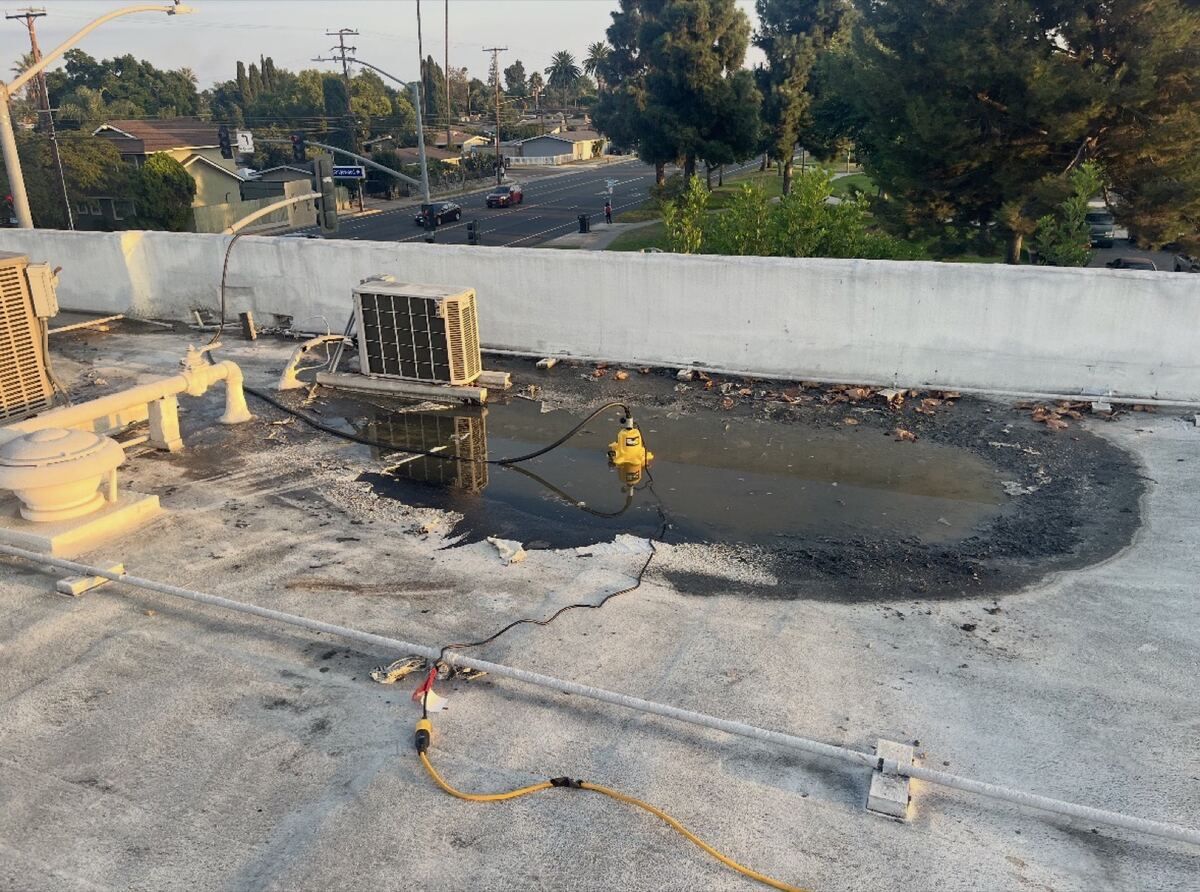
Roof framing and ponding
A roof that ponds is carrying load it was not framed to carry, in the season it gets the most of it.
Spalling and exposed rebar
Exposed steel corrodes faster, expands and breaks off more concrete. A wet winter accelerates a process that is already running.
Balconies and walkways
Wood-supported balconies, stairs and landings are what SB-721 and SB-326 are about, and water is what the inspection is looking for.
Coastal exposure
On the coast the salt is already in the concrete. Ocean-front buildings have the shortest fuse in a wet winter.
A pre-storm assessment, in writing
Not a sales walk. A licensed A and B contractor walks the building, photographs what he finds, and writes it up so you can act on it, budget it, or take it to a board.
Walk
Elevations, roof, joints, slab level and any balconies, photographed as we go.
Write it up
What we saw, where it is, what it is likely to do this winter, and what it takes to fix.
Rank it
Before the rain, after the rain, or cosmetic. Most buildings have items in all three.
Your call
Schedule the work, budget next year, or put it in front of your board. The report is yours whoever does the repair.
Want us to walk your building before the rain? Send the address and we will set a date.
Book an assessmentSend photos of what worries you. We will tell you if it can wait.
A crack, a stain, a low spot on the roof, a joint that has opened. Send what you can see, close and from across the room.
Water already in?
Do not wait on the form. Call (714) 794-2829, then send photos before anything is moved. Get it stopped and get it documented, in that order.
Saltwater already in on the coast? Coastal flood drying →
KneppKraft has worked property loss since the 1994 Northridge earthquake and writes loss scopes in Xactimate®, the format adjusters work in. Insurance restoration →
Common Questions
What owners ask before the rain
How late is too late to do anything?
Sealant and joint work needs dry surfaces and a weather window, so those get harder once the season starts. Crack injection and structural repair can run through winter, they just get slower and more expensive to stage around weather. The cheap fixes are the ones with the earliest deadline.
Our roof already ponds. Is that urgent?
It depends what is under it. Ponding on a low spot in the surfacing is a roofing problem. Ponding because the framing has deflected is a structural one, and the load only goes up when the water sits there.
Do we need an engineer, or a contractor?
Both, sometimes. We hold the A, General Engineering, alongside the B, so we can assess the structure and do the repair. Where a repair needs stamped calculations or a design, we coordinate with a structural engineer.
Sources
- NOAA · ENSO discussion
- NOAA · Seasonal outlook
- ABC News · September 17, 2026
- SF Chronicle · August 22, 2026
NOAA's Climate Prediction Center updates both monthly. We link them rather than paraphrase, because the forecast is theirs and it changes.